Feasibility Study vs. Business Plan: Your Comprehensive Guide to Building a Sustainable Startup
Entrepreneurs often confuse a Feasibility Study with a Business Plan. This article clarifies the fundamental differences between them, highlighting their unique roles in a project's lifecycle. Discover why combining both is the "secret sauce" to attracting investors, ensuring operational efficiency, and mitigating financial risks.
Introduction: Is Your Project Just an Idea or a Profitable Investment?
In the business world, launching without a clear roadmap is an uncalculated gamble. Success begins with distinguishing between the "Evaluation Tool" (Feasibility Study) and the "Execution Tool" (Business Plan). Understanding this difference is what separates a thriving business from a struggling one.
First: The Feasibility Study - "Should We Start?"
A feasibility study is the "survival test" for your business idea. Its primary goal is to answer one question: Is this project viable and economically profitable?
- Focus: Technical, financial, and legal aspects.
- Content: In-depth market analysis, estimation of startup costs, revenue projections, and risk identification.
- Outcome: A final report that determines whether to proceed, pivot, or cancel the idea.
Second: The Business Plan - "How Do We Operate?"
Once the feasibility study confirms the idea’s viability, the Business Plan steps in as the "Operational Manual." It is the document that describes how the project will be managed and grown in reality.
- Focus: Execution, management, and marketing strategies.
- Content: Organizational structure, detailed marketing plans, human resources, and future growth strategies.
- Outcome: A chronological roadmap that management follows to achieve annual milestones.
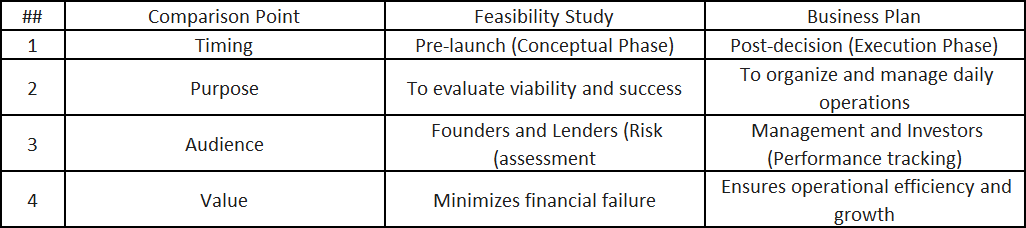
Key Differences at a Glance:
Why Do You Need Both?
- Building Investor Confidence: Investors won't fund a project without proven viability (Study) and won't trust management without a clear roadmap (Plan).
- Reducing Waste: The study protects you from wasting capital on a failing idea, while the plan protects you from wasting time on chaotic management.
- Adaptability: Combining both prepares you for market shifts thanks to prior risk analysis.
Conclusion:
The feasibility study gives you the "Green Light" to move forward, while the business plan is the "Engine" that drives you to the top. At accurety-consulting , we help you craft both professionally to guarantee your market leadership